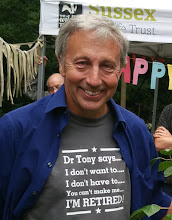
Thursday, 24 September 2009

Concreting over the countryside

A “strategic site option”. This is code for a New Town, and that is what is threatened between Billingshurst and Pulborough around what is now the small hamlet of Adversane.

The proposal is for between 4000 and 5000 houses on about 155 ha of quiet rural West Sussex. That will be a population of around 10 to 12,000 people – bigger than both Billingshurst and Pulborough added together, and about the same size as the much criticised Ford “Eco” Town south of Arundel.

A new town of this size would essentially join up Billingshurst and Pulborough, making an expanded settlement of over 8,000 houses. Add in the 1750 houses also proposed for Billingshurst and 280 for Pulborough and we are heading for a major urban settlement of around 10,000 houses (total), more than 25,000 people. I thought that amalgamation of settlements into a large sub-urban mass was something that we were trying to avoid these days!

Swept away will be ancient woodlands, species rich hedgerows and the foraging areas of one of Europe’s rarest bats. Tranquillity would disappear to be replaced by many thousand extra car movements along the A29 and surrounding roads. This major development would completely devastate the area, changing it from a rural location into an expanse of suburbia.

And how do we know about it - through one of the passages in the Core Strategy of the Horsham District Councils Local Development Framework. Hardly bed-time reading for normal human-beings, but it shows how astute you have to be to stand a chance of arguing against major urban expansion.

I have seen reports tucked away in some of the local papers and the magnitude of the threat is slowly dawning on people. The Local Parish Councils, to their credit, are doing what they can to raise awareness. But I am slightly amazed that our local media, normally so good at these matters, are not jumping up and down.

So who would live in this new town and where would they work? There is no demand for a large work force in the area and no proposal for major industrial development to support the huge population increase. The consultation document itself says that this development would not support a range of services - an admission that it will be a dormitory town for people working elsewhere, probably in London. As such this form of town could be placed anywhere around London, there is no overriding need for it to be in Adversane. There is nothing wrong with people working in London whilst living in and appreciating Sussex. But we are now being threatened by a waste tip for London’s waste down the road at Laybrook, and a sub-urban sprawl designed only to be a dormitory town for London. Isn’t this all getting a bit unbalanced?

This is so often the case. We get big, menacing plans for housing development, being told that we are forced into this because of the South East Plan. But there are other policies in the SE Plan, including policies for nature conservation, and all policies are supposed to be balanced against each other. We have the site allocations for housing, so where are the site allocations for nature development?

Perhaps some policies are more equal than others.

Have your say!

Get the documents and response forms at http://www.horshamdistrictldf.info/LDDS/local_dev_documents_4625.asp
and go along to the exhibitions at Billingshurst Village Hall on 10am on 26th September and at Adversane Village Hall on 3rd October.


Let’s not sleep-walk into a miniature Milton-Keynes.


Wednesday, 2 September 2009

This is not a barren quarry devoid of life!

My last blog posting outlined my general concerns about our throw-away society, in particular highlighting concerns about the proposed Laybrook landfill site as an example of the damage that can be done. I do not know the site but I had an excellent comment back from Pip Edgcombe who has clearly done significant research in the area.

I think this is a comment well worth reading so rather than leaving people to click on the comments box, I though I'd just publish it word for word as a separate blog posting:


This hole in the ground, Laybrook brickworks, does have significant existing wildlife interest. Far from being a barren quarry devoid of life, the varied mosaic of different habitats in and around the brickworks and the fact that it remains relatively undisturbed for much of the time has resulted in a site which supports a diverse mix of invertebrate, bird and mammal species. Many of the UK Biodiversity Action Plan priority species and other high conservation species are represented.

23 bird species with high conservation status were recorded by Cory's consultants (ESL) but based on other records and local knowledge this is a very conservative figure, it could be as high as 45.

There is a considerable bat population at the site with 8 species (including barbastelles) being recorded by ESL at the site and another over the adjacent fishing ponds. Many of the foraging habitats and the hedges used as flight lines by the bats will be destroyed. Work being undertaken at Knepp indicate that ESLs records are incomplete.

Water voles are also present on the site. There are very few colonies anywhere in the Adur, and the existing populations are extremely fragmented and vulnerable to extinction. The proposed landfill, rather than affording protection that is required by law, will result in the total destruction of their habitat.

As far as invertebrates are concerned the site is incredibly rich which is why it can support so many other species. Of the 565 species recorded by ESL, 60 have formal conservation status. ESL themselves describe it as a ‘site with a wide diversity of invertebrate interest’. The reason there are so many insects is because of the wide variety of habitats. Most of these will be destroyed during the construction and running of the landfill site. Mitigation measures are proposed to replace the hedges and plant new trees. However the current habitats have developed over tens, probably hundreds of years. They cannot be replaced overnight. The result will be habitat simplification, with a concomitant simplification of biodiversity that again the more common, competitive, species at the expense of far rarer niche-specialists. In addition, there will be a considerable delay before any restoration is carried out and be functional even at a basic level.

Landfill gas, landfill gas flare emissions, leachate, polluted surface water, dust, litter, noise and vermin are known to impact flora and fauna. Planning permission for the landfill should be refused as it is not needed and not wanted but also on the basis that this is an area of great biodiversity value, the ecology reports submitted by Cory's consultants are not complete and that the full impact on the ecology of the brickworks and the surrounding area has not been assessed.


Very many thanks, Pip, its good to have an insight from someone who knows the area.

Tuesday, 18 August 2009

We can’t throw things away – because there is no “away” left!

Chucking things away on a huge scale is a painful symptom of our modern society.

When you think about it, this makes no logical sense. We take resources that have taken millions of years to build up, make something briefly of use to us and then chuck them away where they become pollutants, make mess and take up space.

This is clearly unsustainable (yes – that “sustainable” thing again – it’s not jargon, it just means you plainly can’t do this for ever!). Furthermore, this causes damage to wildlife in all sorts of ways. One result that is all too obvious to people living in parts of Sussex is the need for landfill sites. We are running out of holes in the ground where we can casually throw our cast-offs so what we are left with is getting more and more damaging.

One site that is causing well-deserved concern is a proposal to fill a clay pit at Lay Brook with waste. This is a site near Ashington, immediately adjacent to Knepp – one of the country’s leading conservation projects.

I have talked about the Knepp estate in this blog before. For more details go to the estate’s own web site at http://www.knepp.co.uk/.

Suffice it to say here that the Sussex Wildlife Trusts has long supported the project and we consider ourselves extremely fortunate to have one of the country’s best re-wilding projects on our doorstep. What is more, it is not just us that support it – friends of the project come from all over Britain (e.g. the Environment Agency and Natural England) and Europe. It has also received warm support from the Shadow Secretary of State for the Environment. See:

http://www.nickherbert.com/Nick_Herbert_visits_Knepp_Wildland_Project.aspx?ArticleID=3356&PageID=65&RefPageID=23

The presence of a landfill so close to its borders could have a major effect. The proposed pit is wet – i.e. it fills up with water. Filling this up with any old waste would be extremely damaging. Dumped waste here would rot, chemicals would leach out and surrounding rivers would be devastated. This pit would leach directly out into the river Adur as it runs through Knepp. That would be the end of any re-wilding attempts. This would clearly not be allowed so, generally, two solutions are proposed. First the pit would be “sealed”, so nothing could leach out. Second, only inert waste that would not rot would be allowed in.

The trouble is that I am not sure this really works in practice.

First a pit will never really be sealed permanently – polluted water will always get in and out somehow, getting into surrounding rivers. Preventing a pit from flooding into surrounding steams becomes even more difficult with the increase in severe rains storms that we are now getting.

Second, can we really trust people dumping waste to only dump the most inert material into a big wet hole? Would anyone really notice the odd rotting refuse sack, oil drum or paint pot (until it started leaching into the surrounding river)?

Furthermore, these holes in the ground often have significant existing wildlife interest, or have the potential to develop it. The largest sand marten colony in Sussex is in an old sand pit for example. Holes in the ground are not just wasted land waiting to be dumped in – they are assets that could have a very positive potential use.

The current issue - Laybrook landfill - will shortly be considered by the County Council. For further details, with advice on how to make representations on the proposal, then the web site http://www.nolaybrooklandfill.co.uk/ is perhaps a good starting point.

However, we shouldn’t only be fighting against landfill sites, instead we should be forming partnership to work together and make best use of these potential assets. In other words we should be pushing for what we do want in these places, not just having to fight against what we don't. For my part I’d like to see a restored, re-naturalised lake and wetland there.

But all of this comes down to our attitude to consumption and waste. If we can’t consume without wasting then we shouldn’t consume in the first place. It may be reassuring to blame the County Council or the landfill companies (and the Sussex Wildlife Trust will oppose damaging landfill along with everyone else), but really they are just dealing with a problem that we are giving them. Obviously we have to produce less waste, obviously we have to reuse and recycle more and maybe there will always be some residue left to dispose of (maybe in an incinerator outside somebody else’s house). But the only real answer is to move to a no-waste society. Idealistic? Well I would say not, indeed our current get it, use it, chuck it approach is a silly ideal, and one that is now failing.

Tuesday, 11 August 2009

Book Review: “Where the Wild Things Were” by William Stolzenburg

I haven’t yet reviewed a book on my blog but this one was so good that I thought I would make a start. “Where the wild things were” looks pretty drab when you first pick it up but when you start reading it a fascinating story unfolds of how big fierce things rule the world (or should do).

We’ve all seen the nature programmes on TV. They are excellent and I am not one to criticise them. Good ones might tell you all about an animal – maybe giving you a year in its life. The very good programmes may tell you more about the habitat in which an animal lives. But there’s the rub – a habitat is generally portrayed as something an animal lives in. It is very rare for us to get a picture of how an animals shape the world they live in. This is a huge gap in the way nature conservation is put across to people - what we should be seeing is animals as integral parts of their habitat.

Animals often drive the ecology of an ecosystem rather than just live within it. For example large herbivores graze areas so, obviously they create grasslands, similarly beavers build dams, blocking rivers and so create wetlands. You can therefore see how animals impact on vegetation and so alter ecosystems. Large predators, however, are often just thought of as something that sits at the top of the food chain. We may think of them as a method of keeping the numbers of herbivores down, but surely a few lions or tigers wandering around cannot have much effect on what a forest looks like?

Stolzenburg, however, shows, in a clear, entertaining and readable way, how top predators are fundamental in shaping whole ecosystems, effectively driving the ecology of areas. Furthermore, he shows that many ecosystems around the world are in a tail-spin of degradation and collapse because they lack predators.

This is an excellent book. We may know that wolves are back in Yellowstone, USA, but nowhere else have I read such a clear explanation on how wolves have changed the behaviour of other species and in the process beneficially altered the vegetation. We may have seen cute pictures of sea otters off the Canadian coast but did you know that they eat large numbers of sea urchins and without otters sea urchin populations would explode leaving them to graze the marine kelp forests to destruction. So, centuries of hunting otter for fur actually resulted in the destruction of a major marine ecosystem.

He introduces us to concepts such as a “trophic cascade”, the idea that if you remove predators then the effects bounce around the ecosystem in unpredictable and destructive ways. For example when wolves were hunted to extinction in Yellowstone then, predictably, deer numbers exploded, vegetation became over-grazed and many plants and animals declined. Less predictably, without wolves, coyote populations increased which hunted Pronghorn Antelopes. When the wolves returned, the coyotes received a tough lesson in top-dog diplomacy! And Pronghorns increased. An interesting insight of how a predator can increase the population of a prey species. Also surprising was the effect on riverside vegetation – when the wolves came back the grazing animals avoided rivers as that is where they got ambushed. The result was less grazing alongside rivers and a huge flush of regenerating wetlands.

Examples pour out of this book developing a powerful argument to show the critical value of predators. From the effect of starfish on mussels to cougars on white-tailed deer, to coyotes on domestic cats, in each case the presence of a predator sends out ripples giving a richer, more diverse, more stable and better functioning ecosystem.

Discussions on what drives the ecology of ecosystems are always fascinating. The world is so diverse that most views are probably right somewhere – often the keystone species will be predators, often large grazers, sometimes ants, fungi, even midges! Stolzenburg makes an excellent case for predators.

Stolzenburg also does not shy away from “political” implications. The deepest resistance to the return of wolves in Yellowstone came from hunters who wanted the maximum number of docile deer that are easy to shoot. Killer whales are now eating otters and seals because we have killed off their main prey – the large whales. This is uncomfortable to both whaling commissions (unhappy that whaling could be damaging ecosystems) and conservationists (who consider over-fishing as the main cause of seal decline).

This book also boosts the case for re-introducing predators, or for carrying out management practices that mimic the effect of predators. Whole ecosystems are suffering, in Britain as anywhere, through lack of predators. We need them back for the health of our own environment, and if we do not get them back we need to find ways of controlling the things that top predators would have controlled.

Tuesday, 30 June 2009

The Big Biodiversity Butterfly Count


The Big Biodiversity Butterfly Count is a fantastic event that takes place between Saturday 4 July and Sunday 12 July. It aims to do what the name implies – to encourage people to engage in the identification and counting of butterflies in Brighton and Hove. To take part, you can pick up a butterfly identification guide and recording form at any library in Brighton & Hove or follow the link on the Big Biodiversity Butterfly Count web site.


Butterflies are easy to identify and are sensitive to changes in their habitat. They are, in most of their characteristics, typical insects, and the impact of environmental changes on butterflies is probably similar to the effects on many other insects. So by counting butterfly numbers we have a measure by which we can easily monitor the rest of biodiversity.

Much of this information you can pick up from the BBBC web site, but I also asked Dr Dan Danahar, who is leading this project, for some further information for me to post on my blog. I expected something about butterflies and just how nice they are. What I received was an excellent articulation of nature conservation philosophy! So rather than plagiarise it and claim the credit, I thought I’d quote it directly – so here it is…..


If you were born during the 1950's you belong to the first generation of human beings to see the world population double during your own lifespan, which is of course part of the exponential growth pattern currently happening to the human population.

Of course if you were born in the fifties, many of you will be coming up for retirement soon and will have had a pretty good life, if you lived in the west. As it currently stands 6.5 Billion people live on the planet and it is estimated that global human population will plateau at between 8 & 10 Billion by 2050. This is rather worrying when you consider that most young people know no other life than one of consumption, utilising natural resources at an ever increasing rate.

Since around 68% of the worlds terrestrial ecosystems have already been damaged by human activity, and around 75% of our marine fisheries are unsustainably harvested, only a small proportion of the earths natural ecosystems remain intact. As we destroy more and more of the worlds natural ecosystems so we also degrade the invisible environmental services that they supply, free of charge.

Ultimately this can lead to one of two possible scenarios. Either keystone species will become extinct and the planet will suffer ecosystem collapse and the sixth mass extinction or the earths biodiversity will become increasingly impoverished, so that when you travel from one part of the planet to another you will only ever see the same species of animal and plant, the weeds that can cope with what humans do to their environment.

So, one of the reasons why we are running the BBBC is to encourage people to become interested in biodiversity, wildlife, to make them bio-literate because we believe that we all need to be as aware of our local biodiversity as stock brokers are aware of the stocks and shares on the stock exchange.

We hope that by looking people will become involved in the fascinatingly complex life histories of our local natural history. We hope that people will learn to value biodiversity.

Let me put it another way:

TRY NOT TO READ THESE WORDS. Of course this is a paradox - as soon as you have read them its too late, because you had to read the instruction to be able to realise you weren't meant to read them. If you can read it is impossible to look at any words with out comprehending their meaning.

So what if it was in some other language that you can't read, like Chinese? Then the information would be concealed until you became familiar with Chinese. Reading the natural world is pretty much the same thing, we have become so unattached to our local environment that we no longer have any real sense of how to read it.

Becoming familiar with local biodiversity is rather like learning to read. So, if you are new at this, the BBBC is like your first reading lesson. Your ABC to Biodiversity if you like. If you can't, read how can you be adequately informed about what's happening in your world?

Of course it’s also true that butterflies are great indicators of environmental change because they are easy to identify, there are currently only 45 species in the Sussex. They are sensitive creatures to, dependent on subtle changes in microclimate, habitat structure, etc., as are most insects.

So by identifying and recording butterflies we hope to make two gains:

1) increased knowledge about year on year changes in our local environment and

2) an increasingly bio-literate populace, a community that values the natural world more that it currently does."


Well done Dan!! Butterflies are nice to look at and a world with them is far better than a world without them. But we all need reminding now and then about the deeper need for nature conservation and the need to re-engage with the natural world.

Thursday, 18 June 2009

Climate Change - a major report indicates what we can expect in the UK

Climate change is on the agenda again today (indeed it is such an important issue that is should never be off the agenda) as Hilary Benn MP, Secretary of State for Environment, Food and Rural Affairs, launched the UK Climate Projections (UKCP09). These give detail to how we might expect the climate of the UK to change in coming decades. for an introduction to these projections go to http://ukcp09.defra.gov.uk/

No-one should be surprised!
Predictably, the projections are not good news, but they should be no surprise to anyone. A “greenhouse effect” was first proposed about 200 years ago and carbon dioxide was identified as the main greenhouse gas around 100 years ago. By the 1970’s it was very clear that adding carbon dioxide to the atmosphere (by burning coal, oil etc), while at the same time damaging the earth’s ability to react to these changes (i.e. by damaging biodiversity) was bound to change the balance of this greenhouse effect - hence global warming. After 30 or 40 years of procrastination at least the subject of global warming is mainstream even if our reaction to it is sluggish.

Inevitable change – adaptation is as important as reducing our greenhouse gas emissions.
The government claims that it will pursue a concerted action programme to address climate change. It remains to be seen whether this will be the case, but they have set out a broad 5-point plan and I am glad to see that “preparing for the future” (i.e. adaptation) is included. Temperatures are very likely to increase by around 2 degrees before 2050 even if we react responsibly now (which we probably wont!), and continue to grow even further after that point. I am not convinced, however, that predictability can be that precise. I wouldn’t be at all surprised if our current relatively amicable climate changed into something that was much more unpredictable, with perhaps wide swings between hot and cold, wet and dry.

A healthy environment must form the basis of any future strategy for climate change.
Whatever happens, our environment must be able to adapt. Consequently we need a long-term vision for land-use. We need a healthier environment where the best sites for nature are conserved, enhanced, expanded and joined up to make the natural environment more robust, allowing people and wildlife to adapt to these changes. For a better idea of what we mean by this see our climate change strategy at:
http://www.sussexwt.org.uk/conservation/page00029.htm
and see our Living Landscape documents at: http://www.sussexwt.org.uk/conservation/living_landscapes/page00002.htm

Furthermore, restoring the natural environment will enhance our essential ecological services, such as carbon storage in peatlands, purification of water through reed beds and flood management in wetlands.

A brave new approach is needed.
However, the current approach of fiddling around the edges of existing policies has failed us for too long. Without a long-term vision for the future of our land with joined up decisions on agriculture, planning, water management and more, the future looks very bleak.

Furthermore, the impacts of climate change on wildlife are not restricted to land. Marine wildlife also needs the flexibility to adapt to climate change. More than 50% of the carbon dioxide we produce is absorbed by the sea which is why we must act now to ensure we manage our marine environment sustainably.


A brave new approach with a large-scale vision is what we are seeking from government.
The Government must now show political will by investing in large-scale habitat restoration and creation. It is vital for the natural environment to be placed at the heart of adaptation programmes.

Tuesday, 28 April 2009

Natural Solutions to Flood Management


It is interesting how the tide is turning (no pun intended!) regarding flooding in this country. Not long ago the only answer seemed to be to just keep pouring the concrete to build up hard defences along rivers and coasts. But - like trying to squeeze yourself into clothes that are far too small – all the excess has to bulge out somewhere. Hard flood defences in one place just mean that the spate in a river builds up and it simply spills out, often catastrophically, at the next weak point.

The Wildlife Trusts’ report - Nature’s Place for Water - launched in November 2008, shows how The Wildlife Trusts are working with nature to provide sustainable solutions to flood management. While flood defence walls remain vital in protecting homes and farmland, if the UK is to address the future effects of climate change, natural solutions to flood management must play a significant role. You can download the Wildlife Trusts report here http://www.wildlifetrusts.org/files/uploaded/Flooding%20web.pdf

There is now a Draft Floods and Water Bill which seems to take a more natural approach to flood management. I haven’t read this yet but, going by recent releases from Natural England, it does seem to recognise that conventional methods of managing floods and coastal erosion may no longer be adequate or sustainable especially in the face of climate change.

Helen Phillips, Chief Executive of Natural England, said: “This Bill must ensure that our natural environment plays a pivotal role in flood management. If we increase its capacity to retain more water it will play a greater role in reducing flooding and consequently our reliance on miles of costly concrete and earth embankments”. She stresses that flood management should embrace natural solutions, such as restoring river channels, increasing floodplain wetlands and allowing re-alignment of the coast.

If you look at a map of Sussex you will often see places that are referred to as flood plains. Now there is a reason for the word “flood” in flood plain – and that is that they tend to flood! Fighting against this is not always successful and even when it is it might just mean that somewhere else might flood instead. Well government policy, it seems, might be accepting this now and as a result we might see more naturally functioning wetland, more wetland habitats and more wetland wildlife (along with better flood defence and a much improved landscape).

The way rural land is managed can reduce rural and urban flooding at the local level. Both the Environment Agency and Natural England should work even more closely together to deliver more schemes that work with natural processes. There are, of course, examples of work progressing in Sussex, with re-naturalisations schemes planned for the Cuckmere (for which I have praised EA in the past) and the possibility of more wetland establishment being discussed for rivers like the Ouse. There are also imaginative schemes being put forward by private landowners who aim to re-naturalise upstream river sections to create attractive wetlands and reduce flood risk down stream.

These ideas, good though they are, will all effect somebody’s land. A more natural approach to flood defence should not just be something that is imposed to the disadvantage of the landowner who happens to own part of a flood plain. Flood management is something that we will all benefit from so it wouldn’t be right if the wider public gained the benefit but the landowner had to bare the cost. This approach must therefore be done in parallel with advice, support and incentives to make this a viable option for a landowner.

So –
- flooding events are likely to get more frequent with the changing climate,
- working with nature is a more sustainable approach to flood management
- working with nature delivers other public benefits as well (wetland wildlife and an improved landscape) and
- advice and incentives should be available to landowners to make re-naturalisation of river catchments a more viable option.

If the Floods and Water Bill achieves all this then we will be moving in the right direction.