Wednesday, 16 January 2019

We have 12 years to save the earth!


Maybe I’m being rather melodramatic, more like the start of a disaster movie than a blog, but it really is way past the time when we should have got serious about climate change.

Global average temperatures are now about 1 degree centigrade above what they were before the industrial revolution.  The consensus is that we must keep any future rise below 1.5 degrees in total.  Effects are already serious; above 1.5 degrees the effects become significantly worse.  Our current trajectory will miss 1.5 degrees by a mile!  1.5 degrees will be bad, 2 degrees could be disastrous for civilisation, but at the moment we will probably overshoot 3 degrees by the end of the 21st Century.  Children born today will then be in their eighties and by then the world will not be livable!  No wonder the younger generation are pretty fed-up and starting to be rebellious!

The Intergovernmental Panel on Climate Change (IPCC) is one of the largest and most well-respected groupings of scientists on the planet.  It is informed by thousands of scientists, submitting research often on a voluntary basis, carefully scrutinised and peer reviewed.  The IPCC has submitted several reports over the years – huge bodies of work supported by extensive research.  The tone of these reports has become more and more serious through the years as we consistently fail to effectively address the climate situation that we are in.

The IPCCs recent report is again a huge body of work.  Chapter 3, for example, looks at the climate impacts of the 1.5 degree rise and has some pretty sobering reading. Alone it is nearly 250 pages long and 60 of those pages are references to supporting scientific study.  Once again it highlights the need to urgently bring our greenhouse gas emissions down.  It is difficult to highlight some of their conclusions without sounding melodramatic!  The climate is now changing.  This is no longer about vague possibilities sometime in the future.  In many respects it is changing faster than predicted; in fact, it seems to be running ahead of the “worst case” scenarios presented a few years ago.  The IPCC therefore stresses that we need to drive a significant turn-around in the next 12 years.

All sorts of statistics could be marshalled to illustrate our predicament.  The analogy that shocked me, however, regards the amount of extra heat going into the world’s oceans because of climate change.  Global warming has heated the oceans by the equivalent of one atomic bomb explosion every second for the last 150 years!

The tone of climate scientists has become more and more dire over the decades.  30 years ago we were warned that we had a few decades to sort this out.  That was probably the time when a sensible, planned transition could have brought us to a new economy that stood some chance of maintaining a stable climate.  By the end of the 1980s / early 1990s we might have got away with immediate action.  At the turn of the century we should have planned an emergency decarbonisation of society.  Today, even the emergency ending of fossil fuel use is unlikely to stop us experiencing at least some climate breakdown.  Prevarication must end – we need to get on with this!

Of course, the response of some is to deny reality – as ever.  But, as one of the IPCC scientists said, “you can deny gravity but if you walk off a cliff you are going to go down”.


Tuesday, 8 January 2019

New year resolution, or rather revolution!

New year resolution revolution


2018 should have been a momentous year for important news.  I don’t mean Brexit, Donald Trump or the state of the economy – these are all second or third level issues.  The important news was all environmental. 

We’ve had warnings about the dire state of the environment for decades.  The effects are now becoming obvious and scientists the world over are issuing reports and statements to try to get world governments to pay attention.  Not that you’d know this from the news outlets.  The media seem more interested in Megan Markle having to open her own car door than they are in the livability of the planet we inhabit!  And, while you would need sharp eyes to spot this in the media, you might have found it even more difficult to see what politicians and leaders around the world were actually doing about the most important issues of our time.

Climate change, the extinction crisis and a rapidly declining environment have led to more than 15,000 scientists around the world to issue “Warningto humanity: a second notice”, possibly the most scientists to ever co-sign and formally support a published journal article, reinforcing the original warning of 1992.  Did you see this as front-page news?  Did you hear about it at all?!!

This invisibility in the media, and dereliction of duty by politicians has led to the growth of “extinction rebellion” a movement that is gaining strength. They claim that governments and media together have broken their social contract with the public they should aim to serve.  Demonstrations are now happening around the world – maybe I’ve missed something, but I’ve heard hardly a whisper in the press.

The message of my generation to the younger generation is “we’ve had our fun now you can clear up the mess”.  Unsurprisingly, there are now many young people who are objecting to this and themselves starting a strong movement to call power to account.

Bella Lack (15 years old), for instance, gave an inspired talk at Chris Packham’s excellent “Walk for Wildlife” (10,000 people marching through London to deliver The People’s Manifesto for Wildlife to No 10, but the eyes of the media seem to have been elsewhere).  Bella rightly criticised older generations for removing the vibrancy of nature that all people have a right to expect.  

And the younger generation has found an international voice in Greta Thunberg, a 15 year old school student from Sweden.  Greta goes on regular school strikes because she feels that there is no point learning science if world leaders do not act on the science they already have.  Her powerful speech at the recent UN conference on climate change effectively told off the 200 world leaders in attendance. Virtually every line of her talk is quotable and I strongly recommend you follow this link and see her giving us all a well-deserved dressing down!  A key theme that again comes out in her TEDtalk is that she can’t work out why there isn’t a vast amount more discussion about the crisis we are in.  Indeed, why are we talking about anything else?  The media should be full of thoughts, discussions, actions and solutions instead of the soap operas, celebrity worship and political pantomimes that we seem to have to sit through.  It’s as though a world war is underway but no one is talking about it.  “You are not mature enough to tell it how it is.  Even that burden you leave to us children”.

Maybe it’s children that will eventually spur us into action.  Some people woke up in 2018, let’s see if the rest of the world rises from its slumber in 2019.  There  is little enough time left!


Saturday, 5 January 2019

New year – new blogs


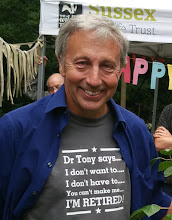
I notice that I have not written a blog since the end of 2017.  My last efforts were a series of 6 about the 1987 storm and what we might have learned from it.  Since then I spent 2018 focussing on managing the Trust, endeavouring to get it to a position when I could retire with as little fuss as possible. 

Theoretically at least, I should now have time on my hands, so it feels timely to re-start blogging again. 

A lot happened in 2018 – a lot of critical news about the environment.  However, with the divergence caused by various political pantomimes going on in the world, the important stuff seems to have been pretty invisible.  (With the honourable exception of BBC Sussex radio who did at least do a decent slot about a recent WWF report – of which more later!).

I was CEO for 12 years.  And it’s a strange co-incidence that the IPCC says we have just 12 years to sort out climate change (more of this in a later blog too).  With species extinctions happening far too fast and a huge reduction in the overall vibrancy of nature, this puts the time scale of necessary action into perspective.  We’re no longer talking about problems for future generations, we’re talking about here and now.  Maybe some urgency is called for….  Time to get hot under the collar!

Friday, 10 November 2017

30 years after the 1987 storm, part 6 – Controllers versus Arcadians


Should we control nature or should we let it control us?  This is more than a question about practical conservation management. 

On the one hand is control.  This may relate to our sense of responsibility and making best use of assets in our care.  Control means we need to be clear about our objectives, make plans and then recognise when have achieved them.  This, however, breeds the presumption that everything must be under our control. 

On the other hand is nature out of our control.  The word “nature” is hard to define but it generally relates to that being outside the human.  It relates to the wild, Wold and Weald – the non-human, and also to “forest” which in one sense means “outside enclosure”.  If we bring nature under our control it stops being nature.  From this we may develop a view that we need to understand nature and work with it.  Help it, maybe, but not control it.  Sharply defined objectives are not relevant.  We need to recognise when good things are happening and allow nature to take its course.  It teaches us to appreciate surprise.

The first is about working logically towards a pre-determined outcome.  The second is about building a system and allowing properties to emerge.

In a practical sense the first approach may be (for example) to plant trees in order to create a planned wood.  The second would be to put in place the processes of regeneration and natural disturbance, let nature run and we then appreciate the habitat that emerges.

Neither is right or wrong, each may be preferable in different circumstances.  We may need to take a very controlling approach where we have a rare or sensitive habitat which might disappear if things go wrong.  However, we may take a far more hands-off approach in low risk, perhaps degraded areas where there is less to lose, and a lot to gain.

This could reflect two different attitudes for life in general, not just our relationship to nature.  On the one hand is the need for control – the Controllers.  On the other is the idea of putting good things in place and letting the future just happen – let’s call them Arcadians.  The two different attitudes can drive two different mind-sets, which find it difficult to understand each other.  “Untamed wilderness” to the Controllers is the worst form of insult, but to the Arcadians it is the very deification of nature.  Controllers want to know the objective and the plan.  Arcadians want to put good stuff in place and see what might happen.

Modern society is tuned more towards control.  This is probably essential – with our population levels and expectations we cannot just leave things alone and hope it will all be ok.  But the need for control may lead to a view that success is only achieved through complete control.  The 1987 storm reminded us that we are not the masters of the environment. It humbled us.   And, what is more, this is not necessarily a bad thing.  Out of control does not mean “wrong”.  Nature out of control can be brilliant!

Like so many extremes, their value is when they are complementary rather than conflicting. 

Control implies responsibility, care and sustainable management.  Sustainable management means we need to understand nature, working within critical limits and so recognizing limits on our ability to control.  So, in a few steps, we move from controlling to realizing the limits of control.  Working in the other direction, appreciating nature for itself reflects a wish to understand nature, how nature can be restored and if not restored then managed.  So in a few short steps we move from appreciating nature to managing it


We need to allow nature to work for itself and then learn about natural processes in order to better understand how management (or control) can be done more effectively.  The two approaches are different sides of the same coin.

Friday, 3 November 2017

30 years after the 1987 storm, part 5 – copying storms


There are two main processes shaping nature: succession, the tendency to grow towards forest, going in one direction; and natural disturbance working in the opposite direction.  The interaction between the two, at all scales and time-scales, creates diversity in nature.

“Rewilding” could be seen as encouraging nature by re-asserting these natural processes – allowing succession to progress alongside re-establishing natural disturbance.  An extra layer to this is the restoration of the things that impact on natural disturbance.  Predators, such as large carnivores, impact on the numbers and behaviours of grazers, such as deer, and so in turn affect natural disturbance. 

Our landscape, however, is very far from natural.  Humans have had a huge impact for thousands of years, probably dating right back to the last ice age.  Restoring wild nature, if it possible at all, is certainly not possible everywhere. 

Maybe there is another set of lessons we can learn from the 1987 storm – if natural disturbance is a good, indeed driving force in nature, can disturbance from humans have a similar effect?

Think of the effects of the 1987 storm.  Areas of woodland were blown flat; light then got into the forest and there followed a burst of regeneration supporting a range of different wildlife which changed as we went through the stages of regrowth.  This created rich and diverse wildlife.  With traditional forest management; an area is cleared, light gets in and there follows a burst of regeneration.  Pretty similar.  There are differences but woodland management basically does the same ecological job as natural disturbance.

One big difference to a wild past is that our forests are but tiny fragments compared to the extensive natural habitat that would have clothed our landscape.  Natural disturbance, however, often needs to work on a large scale.  For instance, 100 acres blown down in a natural forest covering many thousands of acres is just one patch of disturbance.  But in a modern landscape a 100 acre woodland could all blow down at once.  Woodland management, however, effectively creates smaller patches of disturbance in our smaller manged woods.   A large scale disturbance cycle has been replaced by a small scale disturbance cycle - a big natural forest with big holes is replaced by a small managed forest with small holes. In so doing a measure of diversity is retained.

Sympathetic woodland management in a small wood is probably more natural than abandoning it. A small site does not have the scale for natural processes to function whereas management (which you could consider “imposed” disturbance) puts back a proxy for that natural disturbance.

This logic also extends to other forms of natural disturbance and management.  Large mammals would have grazed a wild forest creating openings, maintaining a range of open habitats like grassland and heathland.  Abandonment destroys those habitats but copying nature with domestic animals puts back the natural process of grazing.  Just adding grazers, however, creates over-grazing, potentially reducing diversity not improving it.  Predators would have made grazers move around to avoid being eaten.  Management of domestic grazers by moving them around, avoiding over-grazing and creating patches of different vegetation, can have a similar effect.


The analogies go on.  Beavers dig ditches and create wetlands – we dig ditches and create water meadows.  Wild boar plough the ground and disturb the soil – much of our management (such as extracting logs and ploughing fields) disturbs the soil.  Part of the fun of ecology is seeing how nature functions for itself and then seeing whether there is something in our management that does have, or could have a similar effect.