Tuesday, 19 March 2019

The last best hope!


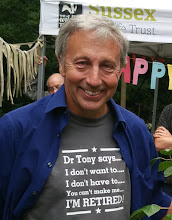
A joint blog written by Tor Lawrence, current CEO of Sussex Wildlife Trust and I.

Friday 15th March 2019 will, we hope, be remembered as a turning point.

This was the day of the biggest climate strike by children and young people yet.  Over 1,000,000 students in over 1,000 locations in over 100 countries on all continents (including Antarctica!) took to the streets to demand action.  Climate change, the environmental crisis, the extinction of species and the breakdown of the earth’s life support systems have spurred a whole new generation into action.  In the words of one 6-year-old’s banner “we get it, why can’t you”.

As the current and the past CEOs of the Sussex Wildlife Trust, we were proud to be there.  But this was the kids' day.  They are leading and we think it imperative we support them.

When we first arrived, Parliament Square and the nearby streets had many pockets of primary age children demonstrating and there was an excitable, but gentle feel to the revolution. Then all of a sudden, taking us completely by surprise, thousands of teenagers streamed from two directions converging into the area in front of Westminster and poured around the square.

This young generation is rightly concerned.  Developed nations throughout the world signed the convention on climate change back in 1992.  Since then the world has emitted more carbon dioxide than in the entire history of the human race before 1992. 

We were warned.  Scientists said clearly at that point that we had a few decades to sort this out.  We’ve now had those few decades.  In that time we’ve moved from climate change, to climate emergency to climate crisis.  It is now beyond crisis - we have left things so late that the next generation, children in school today, will inevitably suffer major consequences.

We are not all naturally activists in the Sussex Wildlife Trust.  Marching on the streets is not our day job – it isn’t, and never will be the core approach to the way we work.  But, in the words of one student from Minnesota, it’s now “so bad even introverts are here”!  We prefer to do careful work gathering evidence, building partnerships, influencing policy and plans, presenting considered arguments, educating, championing wildlife and best practice in land, river and marine management.  This work remains central to our ethos.  We can point to individual successes, we can show species saved, habitats regenerated, policies influenced, people inspired by nature.  But our efforts have not delivered enough of what is needed and the children and young people are right to stand up and challenge us all.

We believe this is a cross-party issue. Everyone, whether left, right or centre all need a healthy environment, all have people with a strong environmental ethic and all have delivered work that they can be proud of; yet it is not enough.  Young people can see through this with the crystal clarity that is the benefit of their age.

This upwelling of strength of feeling from children must now spur real action from us adults with significant change at government and inter-government level, as well as in the private, voluntary and public sectors and from us all as individuals.  The kids mean business - for example there are currently legal actions against governments in France, Germany and the USA stimulated by the campaigns of children.  And the UN Secretary General, António Guterres, will host the 2019Climate Action Summit on 23 September to meet the climate challenge.

We must not fail them 

Whilst marching with the kids in London we saw a baby being carried – less than 6 months old.  Her mum was holding a tiny placard for her saying “I demand climate justice – and milk”!  When this child gets to the age of a retiring Sussex Wildlife Trust CEO it will be around the year 2085.  We are determined to take action to ensure that Sussex and the planet are well stewarded for her and her children’s children. The race is on.

Wednesday, 20 February 2019

The kids are revolting


Friday 15th February was the day that school students around the world took to the streets to demand that world leaders start some serious action to address our environmental crisis.  We had our own excellent examples, for instance here in Brighton.

You could feel various emotions on hearing this. 

First should be shame.  While we might point to all sorts of things that we feel we’ve done, the basic fact is that we have failed.  For instance, in 1992 the UK, along with most countries in the world, signed both the Climate ChangeConvention, and the Conventionon Biological Diversity.  A generation ago we committed to really doing something about the environmental crisis.  Since then, however, we have emitted more carbon dioxide than in the previous 200 years and the world has slipped into its 6th mass extinction.  Extinction rates now are between 1,000 and 10,000 times the background rate.  Our situation is about as serious as the mass extinction that saw off the dinosaurs.

Our generation has failed, and we’ve failed spectacularly.

Second, we might feel enthusiasm.  The kids are revolting, they have got some buzz about them and it doesn’t look like they are going to accept any nonsense.  This is perhaps the brightest ray of hope that has emerged for a very long time.  A failed generation has woken a justifiable anger in young people.

Third is our own anger.  The students raise obvious issues – the climate and environmental crises are the most serious issues of our time, yet they are given a pathetic level of attention by both the media and world leaders.  The contract between one generation and the next has been broken – we are taking their future from them and not even talking about it.  They know it and are not going to put up with it.  The past generation of environmentalists should feel anger for battering our heads against a brick wall trying to raise the concerns, and give positive solutions, yet we’ve been constantly marginalised.

The clarity of the arguments put forward by those on school strike was impressive. 

We may claim that we done a great deal to address the most important issues of our time.  All these kids need do, however, is point to the results – feeble. 

Some criticised them for campaigning on a school day - they should do it on their day off.  A weekend demo, however, would simply not have been reported by the media.  Quiet complaint has been tried – it failed. 

They should be at school working.  “We’ll do our homework when you do yours” was one great response.  “Why improve our knowledge of science when governments do not act on the science they already have?” – a charge that is difficult to answer.

Theresa May said they are wasting teachers time – the response was that while this may be true, governments have wasted 30 years, which is worse!  “2 years bitching about Brexit while the planet is dying” was such a good poster it almost went viral.

As worn out old cynics we might say that they don’t yet know how difficult or complicated it all is – they are being simplistic.  But that is their right.  Youth has a great knack of getting to the nub of a problem – cutting through the fluff and saying it how it is.  The past generation can try to confuse and procrastinate, but the facts speak for themselves.

There is going to be another school strike on 15th March.  A little while ago, Greta Thunberg one of the motivators behind the strike said that they are not there to ask for change but to say that change is coming whether we like it or not.  This is no longer just a demonstration – it’s a movement. 

Tuesday, 29 January 2019

2019 – The Earth’s Sixth Mass Extinction


Climate change is only the second most important issue we face.  Even more important than this is the extinction crisis!

Put to one side the point that climate change and the extinction crisis are linked by the human drivers that cause these problems (consumption, economic growth, politics, population etc), but even an awareness of the crisis seems to feature somewhere below the football results in much of the media.

It is difficult to talk about the seriousness of our situation without sounding extreme.  Perhaps a good illustration is by looking back into prehistory.  Some 250 million years ago the earth went through one of its 5 mass extinctions.  That was probably caused by climate change - about 95% of the species on earth went extinct.  It was the great dying.  However, climate change today is progressing even faster and extinction rates are about the same as they were then! 

Of course, species go extinct all the time.  But it has been estimated that we are losing species about 1000 times faster than would be expected for the normal background rate.That’s about 150 to 200 species a day.

But it now looks like even this might be too optimistic with some scientists estimating that extinction might be 10 times higher. So we could be losing species about 10,000 times faster than we should be.  We are indeed in the middle of the 6th mass extinction!

Extinction is the loss of species.  But alongside this is the huge reduction populations of plants and animals.  We are losing bioabundance as well as biodiversity.  Perhaps we’ve focussed too much on extinction – it is the huge drop-off of bioabundance that is most obvious, and most destructive.

WWF Living Planet report looked at about 6,000 populations of vertebrates (animals with backbones) around the world.  The shock discovery was that the average reduction of numbers in all these populations was about 60% since the 1970s. 

Elsewhere scientists have seen a 75% reduction in insect numbers in Germany in just 27 years and this was in protected areas like nature reserves!  Even more shocking was a resurvey of a rainforest in Puerto Rico.  In a time-span of just 35 years the forest had lost 98% of its insect species.  With this had gone much of the bird and mammal life that relied on the insects. 

Furthermore, this is not just something happening a long way away.  Over a similar time-span in Sussex we know that species like turtle dove, eels and water vole have all gone down about 90%.   Once common birds like house sparrow, starling and song thrush are much reduced and the familiar sound of the cuckoo is becoming much less familiar.

Talk about losses like this and we are often asked “is it important”.  A fair question (although you never get the same level of scrutiny when talking about economic growth, beauty products or the cricket scores!) so is this anything other than the loss of unimportant stuff from a past world. 

David Attenborough answers this far better than I can but we are talking about our own life support systems.  Their destruction is already having untold impacts on our economy (but we avoid worrying about that through the simple expedient of not measuring it) to say nothing of the growing human tragedies around the world.  Every mouthful of water you take every piece of food, every breath you make all comes from the natural world.  Even the condition of the climate and our protection from solar radiation relies on a healthy functioning environment.  Is that important enough for you?!  And, by the way, the majesty of nature make life worth living.  Extinction of experience is as big a trajecy as extinction of species.

Instead of just a regrettable loss of a few special species, we are now seeing the crash of bioabundance and the gathering loss of species as the symptoms of the destruction of whole life support systems.  Again Greta Thunberg sums it up neatly – “I don’t want your hope… I want you to panic….I want you to act as though your house is on fire, because it is.”