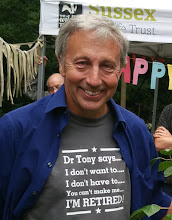
Monday, 14 May 2012

Brighton & Hove and Lewes Downs Biosphere Reserve


The Biosphere is the world in which we live and share with other living things - the zone of life around our planet – for which UNESCO (the United Nations Educational, Scientific and Cultural Organization) is developing a global network of Biosphere Reserves which promote a balanced relationship between people and nature. These are real world-class natural environments.

The Brighton & Hove and Lewes Downs Biosphere Project  is a new partnership which aims to gain international recognition from the United Nations for the special nature of the local environment in and around Brighton and Hove

The Sussex Wildlife Trust is glad to support the project.   The aim is to become a “site of excellence” and part of UNESCO’s family.  Currently there are 580 sites spanning 114 countries including areas as diverse as the Amazon rain forest, Canary islands, to the city surrounds of Paris, Cape Town and Rio de Janeiro.  In the UK there are 7 Biosphere Reserves, including projects at North Devon and on the North Norfolk Coast.

By gaining international recognition the Biosphere bid hopes to enable the partnership to attract funding to improve our environment and to join up current work and activities.  The international accreditation will also help with tourism (economy), education and research as well as the more obvious health and environmental benefits.

The vision of the Biosphere project is to develop a unified approach to better care for, manage and enjoy our local environment. This includes the city itself, surrounding countryside of the South Downs and the sea, so we can help to bring people and nature closer together.  At present the only large conurbation within the project area is Brighton & Hove, but the bid is equally relevant to surrounding towns and villages such as Steyning, Upper Beeding, Shoreham, Lewes, Newhaven, Peacehaven, East Saltdean, Ditchling, Hassocks, Hurstpierpoint, etc.

It is about increasing understanding about how our lives, whether rural or urban, are hugely dependent on the quality of natural environment.  For example, most of the area’s water supply comes from the chalk aquifer, the quality of which is dependent, in part, on how the Downs are farmed and the quality of the biodiversity on the Downs.  The Downs also provides food, including South Downs Lamb, cereals and other crops.  The sea provides locally sourced fish.  Both land and sea are also important for recreational opportunities, but the potential is again related to the quality of that resource.  For example, clean seas and beaches attract visitors, surfers and other recreational users, helping boost the local economy.

Three events are to be held in different parts of the Biosphere to launch the bid.  These will be on Tuesday 22 May 2012, the International Day of Biodiversity.

  • 10:00 - Madeira  Drive, Brighton - Opposite the Brighton Wheel on the mid level promenade.  A flock of starlings has been jet-washed on a Brighton seafront wall as part of a bid to put the international spotlight on the natural attractions of the area. 
  • 15:00 – Devil’s Dyke – National Trust with National Trust members
  • 16:30 – Lewes Downs – Lewes District Council and Sussex Wildlife Trust. 


In addition, between 12:00 and 13:30 there will be a debate:  ‘Food for Thought, what role should the South Downs play in our lives?’  at The Old Courthouse, Church St, Brighton BN1 1UD.  It will be chaired by Professor Martin Price of UNESCO, speakers will include representatives from the National Farmers Union, the Environment Agency, the South Downs Society, the South Downs National Park Authority and myself from the Sussex Wildlife Trust. Tickets are £5, which includes a light lunch of locally sources and organic food. They are available from Brighton Fringe on 01273 917272 or at www.brightonfringe.org.


Thursday, 12 April 2012

Prosperity and Environmental Protection go hand in hand

I very much welcome the Deputy Prime Minister’s recognition that prosperity and environmental protection can go hand in hand.

In a speech made on 11th April Nick Clegg stated that: ‘the environment contributes to our economy in a range of ways, many we don't always appreciate’ and that ‘lean times can be green times’.

His comments, made at the KPMG headquarters, come following a Government review of the EU Habitats Regulations, which concluded they are not a burden on development. The final National Planning Policy Framework, which it was feared would put the needs of development ahead of the natural environment, also showed more of a balance between the economy and the environment. I mentioned the thawing of both of these concerns back in my blog of 30th March, but the Deputy Prime Minister has gone further by clearly destroying the myth that the environment has to be put to one side while we dabble with economic concerns.

The Deputy Prime Minister’s speech is a welcome sign that the Government is moving away from the damaging rhetoric that preceded the budget, which suggested that protecting the environment is at odds with economic growth. Protection of the natural environment is not only compatible with increasing prosperity, but the services healthy ecosystems provide are vital to underpinning a healthy economy.

Indeed I would go further than the Deputy Prime Minister has – the world is moving on quickly and politicians are having trouble keeping up. It is not so much recognising that growth can be green; more that growth must be green. If not then it is not growth at all – the choice is between green growth or no growth. Bearing this in mind, there are signs that we are moving in the right direction – Nick Clegg mentions energy efficiency and low carbon industry for instance. Very good, but these are perhaps the areas where we should already be far more advanced. Far more difficult problems to address will be how to truly reflect the value of nature in all our decision making. The value of pollinating insects, for instance, was mentioned by Nick Clegg – perhaps worth about £1.8bn as the value of pollinating crops. But this is only the tiny tip of the ice berg in terms of all the services that nature provides for us for free. £1.8bn may sound a lot but is a poor approximation of infinity against the cost of ecosystem collapse if we really were to loose our pollinating insects.

I look forward to the Deputy Prime Minister’s promised statements on Natural Capital in the coming months. I urge him to grapple fully with the key messages that came out of the National Ecosystem Assessment and to drive forward the ambitions in the Natural Environment White Paper. The Government must put the recovery of the natural environment at the heart of any plans for economic recovery.

Thursday, 5 April 2012

Water water - anywhere?

So, the much-publicised hosepipe ban is upon us.

This should not be a surprise. It’s been talked about for weeks and everyone should have realised by now that we are living in one of the driest periods since records began. Indeed I heard one commentator say that the water resource situation now is worse than it was at the height of the famous 1976 drought.

People might complain about how somebody should have done something – more pipes, more reservoirs, desalination plants or whatever. But the point is that water is a finite resource. It does naturally replenish but if we use it at a faster rate than it is replenished then we are inevitably in trouble. Dreams of technological fixes, complaints about Water Companies, political niggling or whatever do not overcome a basic ecological resource issue.

Dry periods happen. Whether made worse by climate change or not, there is a great deal of natural variation in the weather so periods of drought are inevitable. Yet we are very vulnerable to this and our actions are making us still more vulnerable.

I heard someone on the radio this morning say that the Victorians would have sorted this out. And perhaps this is the problem – we are still thinking like Victorians. We believe we can build our way out of any problem and when this doesn’t work then we blame the people who failed to build our way out of the problem.

Technology is important, but alone it is not the solution. Furthermore by focusing on techno-fixes we are overlooking the ways that we are making things worse for ourselves. Below I will mention just two of these:

The first relates to how we come by our water.


75% of our water comes from underground aquifers, not rivers or reservoirs. Rainwater falls onto our countryside then slowly percolates into the ground where if forms the bulk of our water resources. What happens to our countryside to encourage water to seep underground is therefore fundamentally important to our water resources. If it falls on the South Downs for instance, is captured by stable, long-established vegetation then it can seep into the aquifer. If it lands on hard surfaces or bare soil then it is more likely to wash quickly into rivers and out to sea rather than going into the aquifer, perhaps causing erosion and flooding as it does so. Having rich and diverse vegetation, such as flower-rich chalk grassland, on our Downs is therefore helping our water resources (and perhaps reducing soil erosion and flooding at the same time). So nature conservation is protecting a vital service, as well as protecting plants and butterflies.

Therefore we should be conserving, expanding and interlinking these rich Downland habitats.

In the distant past about 20% of Sussex would probably have been “wetland” - areas where water naturally collected forming marshes, reed beds and floodplain woodland. Now less than 2% is wetland and much of what remains is highly constrained. In the past these natural wetlands would themselves have encouraged the accumulation of water in aquifers underground. Centuries of drainage might have provided more agricultural and housing land but we have reduced the ability of our land to absorb water underground. As nature conservationists, this loss of wetlands makes us concerned about the loss of wetland wildlife – the reduction of toads and newts, fewer wetland birds like snipe and lapwing, the threat to water voles and otter and the damage to fish populations. Important though these are they are but an indicator of deeper trouble regarding a hydrological system on which we are totally dependant.

Therefore we should be restoring wetlands, expanding them and re-naturalising valleys, financially encouraging farmers to farm in ways consistent with wetland habitats rather than requiring their drainage.

The second relates to our demand for water.

We use enormous amounts of water. Each one of us, on average uses 150 litres per day. That’s over a tonne a week each. With 1.4 million people in Sussex that means we use over 200 million litres a day - from a water resource that is not currently being replenished. Even this is only the tip of the iceberg. Many of the things we use or buy have a “water footprint” – they use water in manufacture and transport. For instance one cup of coffee needs about 140 litres of water to be grown, processed and transported. But even ignoring this, there are too many of us in the South East and each of us is putting too much demand on water. So we need to reduce our demand. There are plenty of water saving devices and water efficient appliances, and plenty of alternative ways of living in order to use less water. We just need the will – a general rethink about a resource that we must really understand is finite.

However, whilst leafing through Wealden District Council’s development strategy (most districts have them, I just happened too see this one) I see a list of house building allocations – 9600 homes to be built in the next 25 years, that’s about 25,000 people. This would increase our water demand by about 3.7 million litres a day, just for Wealden District. If you add in all the other house building plans for the rest of Sussex then you really get the picture of a planning system that is not paying any regard at all to environmental limits. We may need house building, to upgrade or replace existing housing stock, but at the moment our plans are based on a presumption of ever increasing expansion. In a finite world with finite resources and particularly with finite water – this is madness.

Friday, 30 March 2012

Planning reforms and habitat regulations

Back in December last year I expressed major concerns about the direction the Chancellor of the Exchequer seemed to be taking with the environment. Basically he saw it as a block on the economy – “gold plating of EU rules…. placing ridiculous costs on business”.

At the same time we saw a draft National Planning Policy Framework (NPPF) that again threatened the simplistic stripping away of environmental protection in the mistaken belief that, against all the evidence, it was this that was holding back the British economy.

Fortunately more sensible voices seem now to have been heard, I suspect perhaps including some words from our own Sussex MPs.

The NPPF has now been published and it is an improvement over the draft. The Government has now recognised the importance of planning positively for the natural environment and of including Local Wildlife Sites and Nature Improvement Areas. It is also good to see the ambition to achieve net gains for nature, specifically referencing the Natural Environment White Paper. Local Authorities now have the clear steer needed to help secure nature’s recovery by embedding policies to create vital ecological networks and protect important wildlife sites and species in local and neighbourhood plans.

The emphasis on economic growth still remains but at least the definition of sustainable development is a little better and the artificial polarity of environment versus economy, implied in the draft, seems to have gone.

Government makes great sway of reducing 1000 pages of planning guidance down to just 50. It remains to be seen if this is a good thing. Those 1000 pages were there for a reason and had been built up to provide clarity. Stripping that away could be a recipe for chaos, as development after development fights their case through Public Inquiries. Or maybe it will set a trajectory, perhaps supported by technical notes to provide the needed clarity.

So it is not quite as bad as I thought it was going to be. But “not quite as bad as I thought it was going to be” is hardly great praise. Maybe the proof of the pudding will be in the way that some of the localisation principles come into play. Will this be true local decision-making (what development goes where…) or will it actually reduce local say (government sets the development and locals are free to decide on what colour the gates should be painted!).

Part of this apparent assault on the environment was a review of the Habitat regulations – regulations used to protect our most important environmental assets. However, this has been a constructive process and the Wildlife Trusts have been able to engage fully. Unsurprisingly, the review found no evidence of “gold plating” of the regulations and even delays to development were only found in a tiny fraction of cases. I am relieved that Caroline Spelman was able to defend the principles and purposes of these Directives. Perhaps it is worrying that there was so little evidence of development being adversely effected by the regulations – maybe the only way to keep government happy has been to show how ineffective the regulations actually are! In practice, however, it probably shows how good negotiation can achieve good outcomes for both the economy and the environment when people make the effort.

Nevertheless, I remain concerned about some of the rhetoric still coming from the Chancellor. We still hear tales of global business being diverted from the UK, loosing hundreds of jobs to Germany and the Netherlands (who, incidentally, have environmental regulations as good as or better than ours), of restrictions holding back the economy and so on. Yet this is at variance with the evidence (places with strong environmental protection tend to have stronger economies) – a point almost never picked up by the media.

Friday, 16 March 2012

Green or Grey? Which direction will the budget take?

We have seen several good signs over past years as governments, of all political persuasions, seem to get a better understanding of the value of nature. I mentioned the South Downs Nature Improvement Area a while ago for instance. However, against some of these good news stories are worries about the coming Budget Statement.

Our concerns have been articulated by Stephanie Hilbourne, CEO of the Wildlife Trusts nationally, in The Wildlife Trusts Pre-Budget Statement:

Society has spoken out repeatedly against policies that put short-term profit ahead of our countryside and wildlife, eroding our natural capital and quality of life. The budget next week (21 March 2012) will show whether the Government has chosen to listen.

It will test whether the Government is still at odds with itself as it was in the pre budget statement. We are unclear which side of its personality it will express.

On the one hand its Natural Environment White Paper (June 2011) states that it “wants this to be the first generation to leave the natural environment in a better state than it inherited”, a statement which we wholeheartedly support. This point is further reinforced by the National Ecosystem Assessment, (also June 2011), which makes a compelling case that failing to address declines in ecosystem health, habitats and species, will have a significant effect on the well-being of society, as well as having environmental and economic costs. The Government has committed to putting ‘natural capital at the heart of government accounting’.

On the other hand Government is pressing forward with new road building and priming the scene for more development with less planning control and even fewer environmental regulations, all in the name of growth. Comments made in the Autumn Statement on the Habitats Regulations, the ‘red-tape challenge’ and the ill-conceived planning reforms, show an out-of-date approach casting regulation and the environment as enemies to growth.

Since the Chancellor suggested ‘gold plating’ of European Regulations is hindering development, we have had to devote considerable charitable resources to participating in the review of the implementation of the Habitats and Wild Birds Directives.


The Wildlife Trusts work on the ground with developers every day and we know that the regulations are not holding back developments. We are pleased the review appears to have confirmed that view and concluded that the regulations are neither ‘gold plated’ nor an excessive burden on business. We do, however, acknowledge that there are measures that can be taken to streamline and clarify processes. Now we wait to see if the Treasury will accept the outcomes of the review.

Rather than being an obstacle to economic productivity, the environment is the very basis of it. And there is a growing body of evidence to demonstrate the fact. We appeal to the Prime Minister to champion long-term, sustainable economic policies that will bring much-needed prosperity without destroying the natural environment that millions hold dear.

To tear apart environmental regulations and weaken planning laws would be to take a huge step backwards. A Government seeking to be progressive and the greenest ever would certainly retain this established good practice.

Last century this country saw devastating declines in wildlife that only slowed towards its close. Far from undoing the laws that were created to stem this tide of loss Government should now be introducing new measures to restore our ecosystems and put our stewardship of the natural environment at the heart of government policy.

Monday, 27 February 2012

A Nature Improvement Area for the South Downs

I was delighted to hear that the South Downs has been awarded some £608,000 to become one of the Nations 12 pilot Nature Improvement Areas (NIA). We have been working with the South Downs National Park Authority, along with 26 other partners across the South Downs, to help develop the proposal and this recognition of the project is great news.

NIAs were one of the good commitments that came out of the Natural Environment White Paper published last year, the aim being to enhance and reconnect nature on a landscape scale.
http://www.naturalengland.org.uk/ourwork/conservation/biodiversity/funding/nia/default.aspx
The White Paper stated that government wished to see “NIAs wherever the opportunities or benefits are greatest, driven by the knowledge and vision of local partners”. The 12 pilot NIAs, including that for the South Downs will hopefully therefore just be a starting point.

As pilot NIAs, the successful bids therefore aim to pilot something. The very clear message from the National Ecosystem Assessment, reflected in the White Paper, is that nature is not adequately valued in our economic decision making. We rely on nature for everything and yet most of the goods and benefits we get from nature (ecosystem services) are ignored or taken for granted. The South Downs pilot NIA aims to look at one small part of that equation.

Our chalk downland is vital for the survival of some of our most cherished wildlife – such as the orchid-rich downland turf and uncommon butterflies such as the Duke of Burgundy fritillary. As nature conservationists we would like to enhance, expand and join up this valuable habitat. This would be to the benefit of downland wildlife but in the process could improve the Downs in terms of the benefits people get.

Obviously we get food from the Downs – and it is the sensitive sheep-grazing regime that has created the downland landscape we know today. So food, in particular meat from lamb, is a clear benefit.

But a well-maintained downland turf also allows clean water to percolate underground to replenish our water supplies. We get nearly 80% of our water from underground aquifers; erosion, pollution or an excess of fertilisers can damage this and result in large treatment costs.

The South Downs is also a major green-lung to people in Sussex, not least for the major urban centres in places like Eastbourne and Brighton. The enjoyment of the Downs for recreation, exercise or even just the chance to see a Duke of Burgundy fritillary is another benefit we all get which is impossible to put a price on.

A large number of other services are also provided by a rich environment – far too many to list, or put a price on (what price on a bee that pollinates our crops…). But the South Downs NIA will try to make a start at recognising the wider benefits provided by a wildlife-rich landscape.

The farmers of the South Downs are fundamental to all of this. Environmentally sensitive farming is an ethic to many farmers but their returns for practicing it are limited. At present, if they are lucky they may get an economic return by producing food. But all the other benefits they produce are barely recognised. I hope the NIA will help to find ways of rewarding people like farmers and landowners for the benefits we all receive – maybe by looking again at our agricultural incentive schemes or by finding novel sources of funding.

Monday, 20 February 2012

Water water everywhere – except when there isn’t!!

Whilst I am writing this there is a meeting going on in London between government, the water industry and the Environment Agency to discuss a likely drought this year.

It may seem strange, in wet, soggy Britain to talk about a drought, especially in winter, because it’s always raining here isn’t it? Well, when you think about it, how much rain have we actually had? A bit of drizzle last week, one downpour a few weeks ago, but apart from that - almost nothing.

Reservoirs, which supply about 20% of our water, are less than half full. 80% of our water comes from underground aquifers, mostly under the South Downs, and these pretty low on water too – probably as low as they have ever been. They are supposed to be full in winter and only get low later in summer. Streams that should be coming out of the South Downs are either low or non-existent, and areas that should now be wet are dry.

Obviously there will be wildlife effects – fish won’t be able swim upstream to spawn, wetland birds like redshank, snipe and lapwing will suffer, there will be fewer invertebrates that feed the rest of the food chain and wetland plants will be more restricted and flower less. Low water levels in rivers will also mean that pollution incidents will be more severe as there is less water to dilute them.

People are therefore coming forward with their own solutions to the problem – desalination plants (hugely expensive, use up large amounts of energy and produce saline pollution), a “national grid” for water (but water is heavy and it would take enormous amounts of energy to pump over large distances) and, of course, more reservoirs.

But reservoirs are not a panacea. To build them we would have to flood what is already there so could wipe out any existing wildlife interest, they are also hugely expensive and might take 20 years to become operational. Also – do the sums – we only get 20% of our water from reservoirs so even if you managed to double their area (unlikely) you would only increase the amount available by 20%. With the population increases, and the per capita consumption increases we talk about, that will not get us very far. And that’s assuming there is enough rain to fill them.

No – the problem is deeper than this. There are too many of us, each with too high a water demand on too small an area. The result is that there is now less water per head of population in the South East than there is for people in Ethopia.

We may be able to achieve some very minor improvements through these technological fixes but we are running up against real environmental limits. Overall, techno-fixes like these will be about as successful as doing the rain dance that was talked about on BBC local radio this morning. And techno-fixes will come with their own problems which could be as bad, or worse, than water shortage.

Water is one of those resources that fundamentally questions our basic assumption that we are able (indeed have the right) to expand consumption in all directions no matter what.

There is only so much water, damage to wetland wildlife indicates that we have over-stretched the resource and the only answer is to live within environmental limits rather than imagine that there are magic technological solutions. This means using less water.